Architecture

Get in touch at jzkekst@me.com

Chromasonic Pavilion
Fall 2025
03
CHROMASONIC
PAVILION
A synesthetic pavilion translating sound into light and motion
The Chromasonic Pavilion is an experiential installation designed to mimic synesthesia, a phenomenon in which stimulation of one sense triggers involuntary experiences in another, such as seeing color in response to sound. The pavilion translates auditory input from voices, instruments, or ambient noise into coordinated motion and illumination, using frequency and amplitude to control the speed, hue, and vertical displacement of LED panels. Grasshopper was used for the entirety of the project, generating a parametric script that converts acoustic data into geometric and material responses in Rhino, demonstrating computational creativity while connecting it to physical structure.
The roof geometry, inspired by Tadao Ando, Kenzo Tange, and the Thomas P. Murphy Design Studio, is composed of concrete tiles with mirrored undersides and thin gaps that allow daylight to filter in, producing shifting patterns of light. Combined with the responsive LED panels, the interior becomes an immersive environment where sound is perceived as both visual and kinetic energy. Visitors interact with the space as the floor ripples and illuminates in real time according to individual and collective input, revealing the normally invisible structure of sound and demonstrating how parametric design and responsive systems can transform abstract phenomena into tangible architectural experiences.
Advised by Professor Juan Yactayo, AIA

The pavilion relies on parametric systems to translate user-generated sound into precise and coordinated movement across the panel field. Each panel responds according to two key aspects of the sound: frequency and amplitude. Frequency determines the color of the LED illumination as well as the speed of each panel’s movement, while amplitude sets the height of extrusion and the brightness of the light. By processing this data in real time, the system ensures that all panels respond smoothly and consistently to varying pitches and volumes. This coordination allows the entire surface to act as a single responsive instrument, producing continuous, flowing patterns that are always aligned with the acoustic input. The result is a dynamic, evolving field that visually reflects every nuance of the user’s sound, creating a highly controlled yet perceptually immersive experience. This parametric approach ensures that even complex or overlapping sounds are translated into coherent, readable patterns, allowing visitors to fully perceive the relationship between their input and the pavilion’s response.
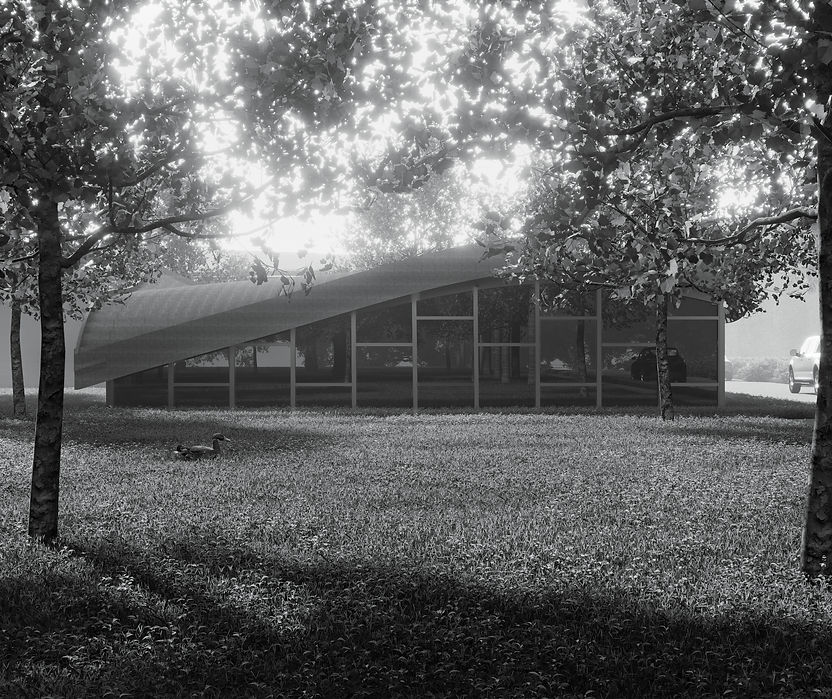

The pavilion’s material palette shapes how sound behaves within the space. Concrete floors provide mass and reflectivity, emphasizing lower frequencies, while tinted glass walls with aluminum mullions transmit and filter sound, creating subtle echoes. The concrete tile roof includes carefully spaced gaps, allowing sound to disperse while introducing daylight. Interior mirrors on the tiles amplify the colors of the LED panels and visually extend the sound response throughout the room. This combination of reflective and absorptive surfaces heightens auditory perception while maintaining clarity and richness in the acoustic environment.


Grasshopper was used to create a script translated into Rhino to generate a model that reacts to sound in real time. The script converts audio into two numeric parameters: frequency and amplitude. Frequency is mapped as an integer from 1 to 88, corresponding to piano keys. Amplitude is a continuous value scaled to the dynamic range of instruments for geometric operations, forming a consistent data structure. The soundwave driving the system is defined by:
y = A × cos × (2π × F × T)
where A is the remapped amplitude and F the input frequency. The function is evaluated on a circular grid indexed by radial distance to create ripples with phase offsets. Each frequency maps to a unique RGB triplet along the visible spectrum, while amplitude defines maximum panel extrusion. Extrusion and color fields propagate outward in time steps, forming a mathematically defined ripple from the origin.

The system moves LED panels using Linear Electromagnetic Actuators, which generate smooth linear motion via controlled magnetic fields without gears, pistons, or rotating parts. The magnetic drive moves a shaft along a precise path with low friction, enabling subtle, repeatable adjustments in height and light while maintaining long-term mechanical stability. Traditional pistons create friction, vibration, and noise, respond slowly, and lack the precision for rapid pitch and volume changes, which can disrupt an acoustic-focused environment.
Linear Electromagnetic Actuators avoid these issues through direct electrical control, providing rapid, accurate responses. Panels rise, settle, and shift in coordination with sound input, with small acoustic variations immediately reflected in height and illumination. Their near-silent operation preserves the auditory environment, ensuring all perceived sound originates from the user rather than the mechanism.


C2 + E4 + G7
C Major Chord
Keys 16 + 40 + 80
Frequency is measured as cycles per second and is first mapped to the nearest of the eighty eight piano keys using standardized pitch intervals that assign each key a fixed frequency center. The system identifies the input frequency, determines its key position, and converts that position into a numerical index along the keyboard spectrum. This index is then aligned to a continuous gradient that represents the visible color range from red to violet. The mapping assigns lower keys to warmer hues and higher keys to cooler hues in order to maintain a consistent perceptual logic. The final output produces a stable hue value that reflects the tonal height of the incoming sound. The conversion maintains continuity so that small pitch changes generate smooth chromatic shifts. This process establishes a one to one visual identity for any musical frequency.
